
Stone County Arrest Records Explained
An arrest record begins when an officer takes a person into custody and books them in. In Stone County, most bookings run through the Sheriff's Office under Sheriff Todd Stewart at the Stone County Regional Correctional Facility. The record notes the arresting agency, the booking number, and the booking date. It does not decide guilt. A charge record is a different thing. Once the arrest is done, a prosecutor weighs the facts and files the formal charges with the court clerk. Those charges are what the court then tracks through the case.
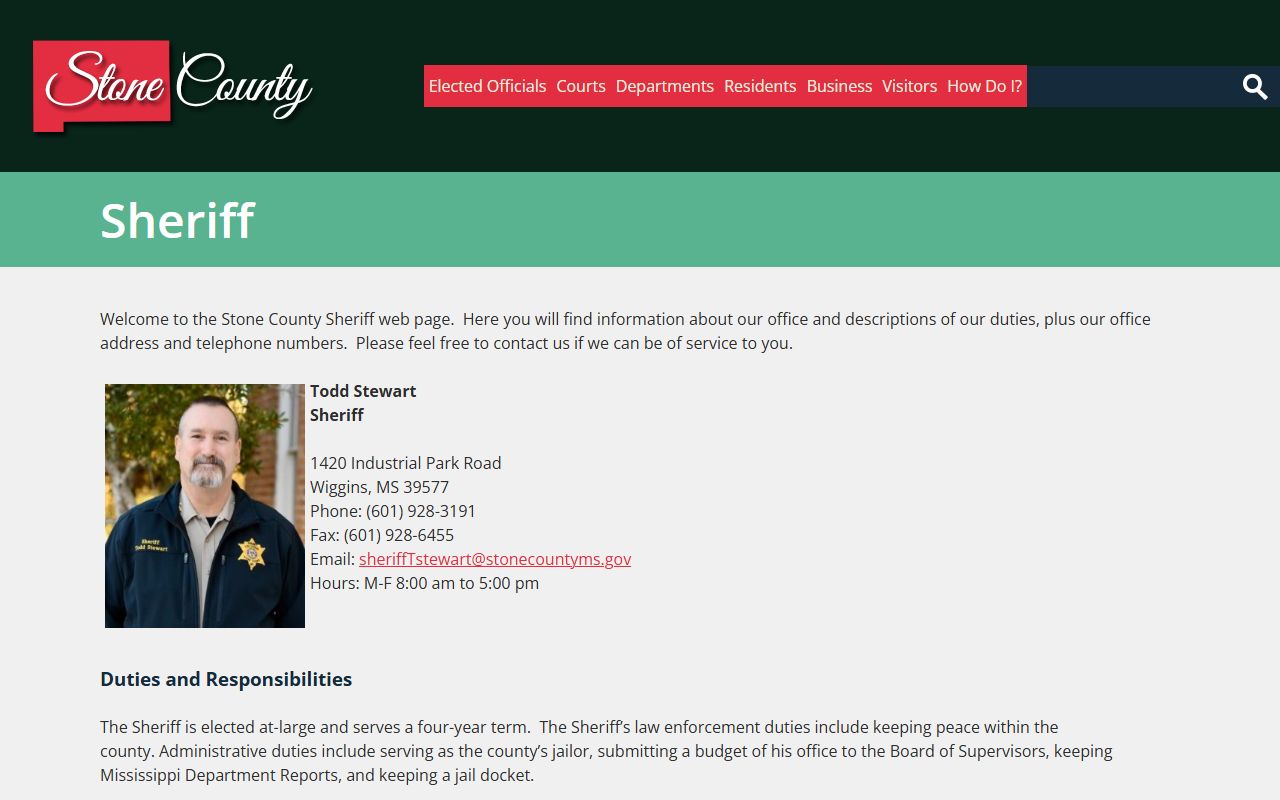
The official Stone County Sheriff page outlines the office's jail and booking duties. The sheriff serves as the county jailor and keeps a jail docket noting each warrant or mittimus for a person placed in the county jail.
It helps to keep the two sides apart. The arrest and booking side lives with the sheriff and the jail. For the jail roster and booking detail, the Stone County inmate records page is the better starting point. The court charge record is what the prosecutor filed, and it follows the case as it moves forward. The full case file, the plea, and the outcome sit on the criminal court records page. So the court charges after arrest are only one part of a larger file.
How to Find Stone County Charge Records
Stone County charges live in more than one place. There is no single county portal for every record. Circuit Court criminal and civil cases from 2008 to current are online through Mississippi Electronic Courts, and the local clerk says to pick Stone Circuit from the court list. But a felony arrest does not create a Circuit Court file right away. There is no circuit file until a grand jury hands up an indictment. Before that point, the charge often sits with Justice Court or Wiggins Municipal Court.
The court case search runs in a few short steps.
- Open Mississippi Electronic Courts and choose Stone Circuit from the court list.
- Search by defendant name or cause number. Stone County criminal cause numbers start with the pattern B6601.
- Open the case and read the list of filed charges.
- Check each charge for its code, its level, and its current status.
If a case is not online, call the office that holds it. The Circuit Clerk answers at 601-928-5246 for indicted felonies and circuit civil suits. Stone County Justice Court takes calls at 601-928-4415 for county misdemeanors, traffic, and early felony steps. Wiggins Municipal Court answers at 601-928-5443 for city charges. The booking side, with bond and charge type, shows on the jail roster.
The Stone County Detention Center roster, linked from the sheriff page, lists active, recently booked, and recently released inmates. Each profile can show the charge description, charge type, bond amount, fine amount, booking number, booking date, and arresting agency.
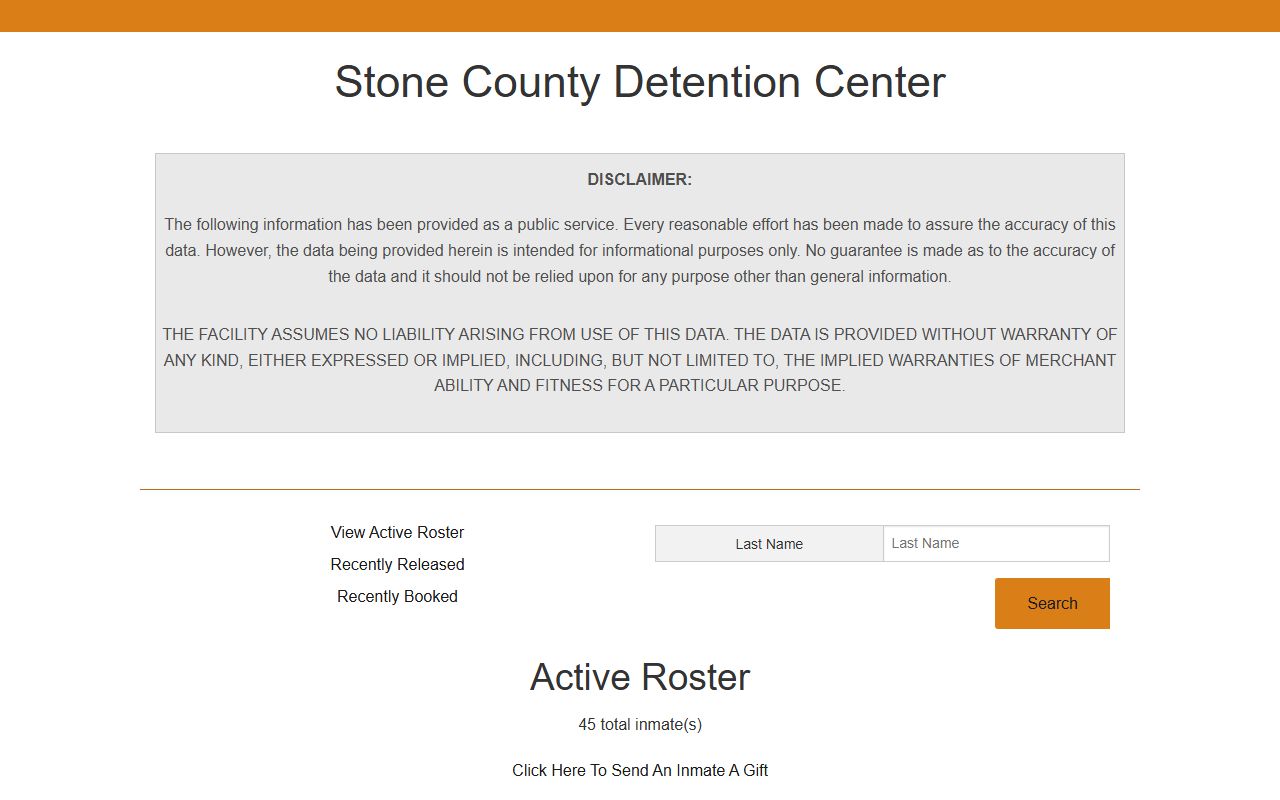
The roster is informational only and carries no guarantee of accuracy. Note: the roster shows people already booked, so it is a custody list, not a live charge index for everyone facing court charges in the county.
Charging Documents After an Arrest
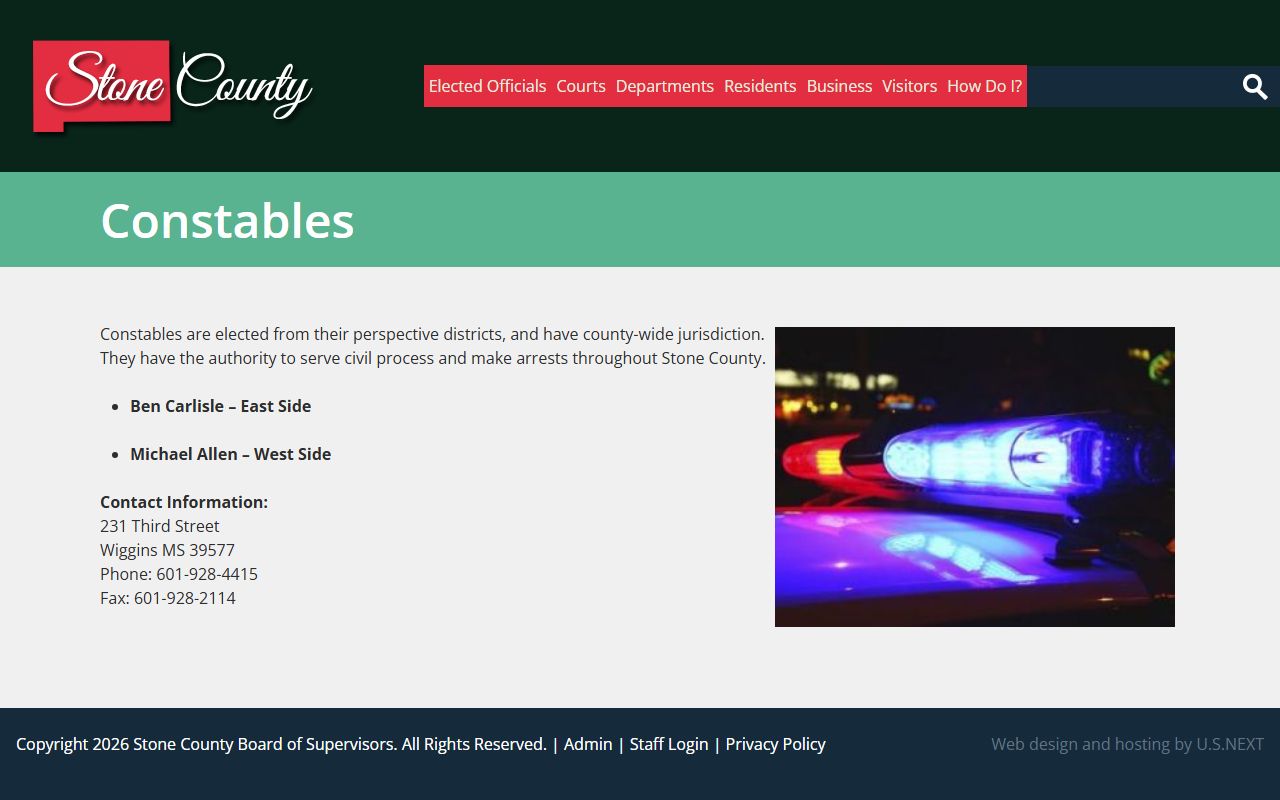
The charge record starts when a charging document is filed. An arrest can come from the Sheriff's Office, Wiggins Police, the Highway Patrol, or a constable. Stone County's two constables, Ben Carlisle and Michael Allen, hold county-wide authority to serve civil process and make arrests. After the arrest, the prosecutor decides the formal charges and files them with the court. There are three main charging documents, and which one is used depends on the charge.
The official Stone County constables page confirms that authority. Constables work out of the Justice Court office on Third Street in Wiggins, where many early charge filings are handled.
A complaint or affidavit is a sworn statement that starts a lower-court case, often for a misdemeanor. An information is a charge filed directly by the prosecutor without a grand jury, used for many felonies. An indictment is the charge a grand jury votes to bring, and in Stone County a serious felony does not reach Circuit Court until the grand jury indicts.
Who files the charge depends on the level. District Attorney W. Crosby Parker and Assistant District Attorney Matthew Burrell handle felony prosecution for District 2, which covers Stone, Harrison, and Hancock counties. County Prosecuting Attorney Thomas M. Matthews III represents the state in lower-court matters and can present cases to the grand jury. So the same arrest can pass through more than one prosecutor before the final charges settle.
| Complaint | Information | Indictment | |
|---|---|---|---|
| Filed By | Officer / Prosecutor | Prosecutor | Grand Jury |
| Common For | Misdemeanors | Many felonies | Serious felonies |
| Court | Justice / Municipal | Justice / Circuit | Circuit Court |
| Starts | The case | The case | The circuit case |
Stone County Charge Status Terms
Charges rarely stay fixed. As a case moves, a charge can be amended, reduced, added, dropped, or dismissed. The status tells you where each charge stands right now. Reading it correctly matters, since a dropped charge and a pending charge mean very different things. One common term is nolle prosequi, Latin for "unwilling to pursue," which is a prosecutor's choice to drop a charge. The table below sets out the terms you are most likely to see.
| Status | What It Means |
|---|---|
| Pending | The charge is filed and active; the case has not been resolved yet. |
| Amended / Reduced | The charge was changed, often to a lesser offense or a lower level. |
| Dismissed | A judge ended the charge, so it no longer moves forward. |
| Nolle Prosequi | The prosecutor chose to drop the charge before a verdict. |
Charges vs. Convictions
A charge is not a conviction. Being charged means the state has accused a person and believes there is probable cause. A conviction comes only after a guilty plea or a verdict, and it must be proven beyond a reasonable doubt. Both can show up as public court records, yet they carry very different weight. Many charges are later reduced, dropped, or dismissed, so the charge alone does not tell the whole story.
| Charge | Conviction | |
|---|---|---|
| Stage | Accusation | Verdict or plea |
| Burden of Proof | Probable cause | Beyond reasonable doubt |
| Outcome Set | No | Yes |
| Public Record | Yes | Yes |
Note: a charge can read as serious on a roster, yet the final court record may show it reduced or dismissed once the case ends.
Sealed vs. Expunged Stone County Records
Some Stone County charge records can be closed to the public. Mississippi law lets eligible misdemeanor and certain felony records be expunged by petition under Miss. Code Section 99-19-71. The Circuit Clerk notes that people who finish a non-adjudicated probation sentence may petition to remove the record. Youth court records are confidential by statute and are not searched like adult cases. Sealing limits who can see a record, while expunction goes further and treats it as removed.
| Sealed | Expunged | |
|---|---|---|
| Visibility | Hidden from public | Removed / treated as never existed |
| Law Enforcement | Limited access | Very limited |
| Eligibility | Youth records under Miss. Code 43-21-251 | Eligible offenses under Miss. Code 99-19-71 |
Stone County points residents to the Expunge Mississippi tool to check eligibility. The confidentiality of youth court records is set by state law, and a judge decides whether a petition meets the statute.
Stone County Charge Codes and Levels
Each charge ties back to a statute, and the code names the law the person is accused of breaking. Mississippi sorts offenses by level. A felony is the most serious class and can carry prison time. A misdemeanor is a lesser offense handled in Justice Court or Municipal Court. One arrest can produce several separate charges at once. The jail roster labels each charge as a Misdemeanor or a Felony and lists a bond amount and fine amount beside it.
A sample Stone County inmate profile shows how this looks in practice. It lists the charge description, the charge type, the bond amount, and the fine amount in a single charge table.
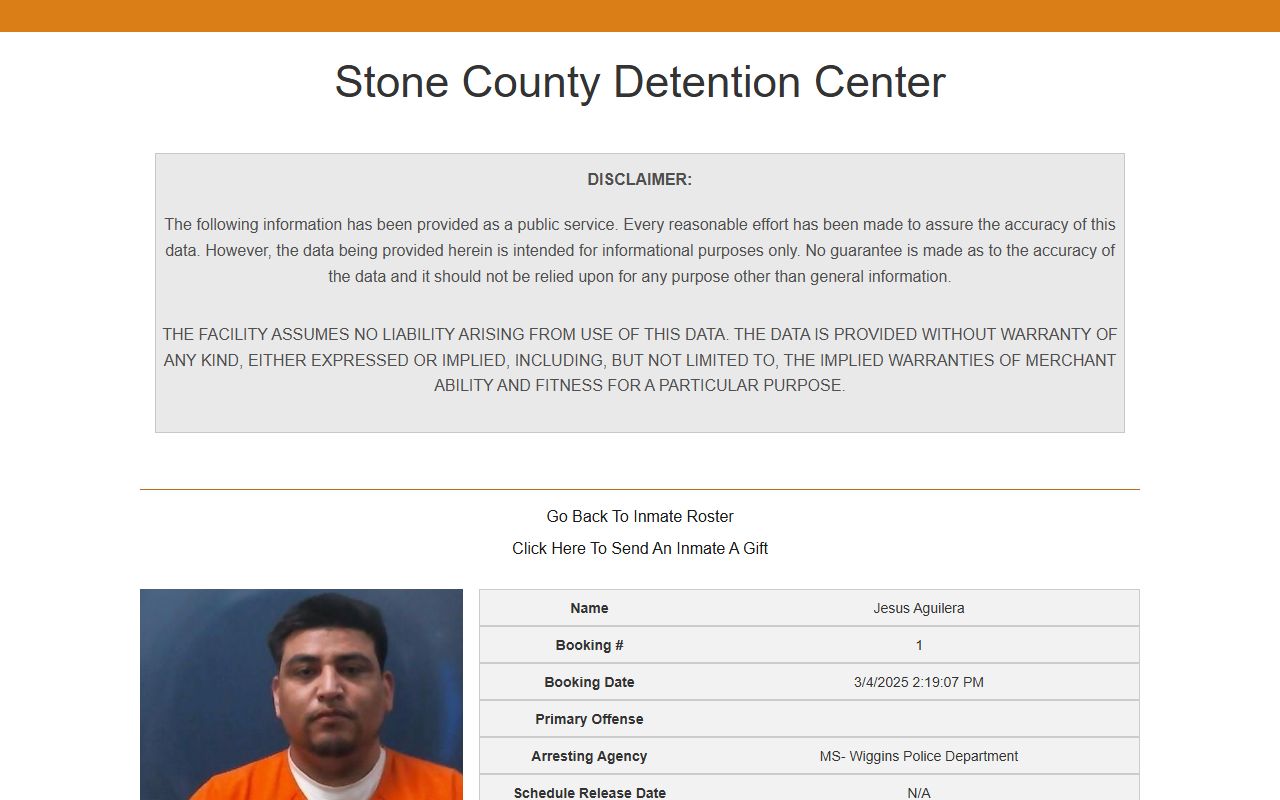
The profile pairs each charge with its level, so a reader can see at a glance whether a count is a felony or a misdemeanor. The full court file, the plea, and the sentence are tracked separately in the Stone County criminal court records, where the disposition for each count is recorded.
Statewide Charge and History Lookups
Some charge information rolls up to the state level. Once a person is sentenced to state custody, the Mississippi Department of Corrections inmate locator can confirm the status, and it searches by first name, last name, or MDOC number. Sex offense records appear on a separate state registry. These tools are narrow. They do not return a full criminal history for any name a member of the public types in. Note: a complete state criminal history check in Mississippi runs through authorized channels, not through a casual public name search.
The MDOC inmate search covers sentenced offenders, and the Mississippi Sex Offender Registry covers registered offenders. For broader public records, the Mississippi Public Records Act sets the general right of access, though court records remain subject to sealing, expunction, and redaction.
Background Checks and Arrest Records
People use arrest and charge records for many reasons. A casual lookup to read a public docket is one thing. A formal background check for hiring, housing, or credit is another. Those formal checks fall under the Fair Credit Reporting Act and must run through a regulated consumer reporting agency that follows strict rules. A simple online record search does not meet that standard. The charge record on its own also may not show whether a charge was later dropped or expunged.
Important: This website is not an FCRA-regulated consumer reporting agency, and its records may not be used for employment, tenant, credit, or insurance decisions.
Restricted Stone County Charge Records
Not every charge record is open. Mississippi law keeps several kinds closed to the public, and online tools will not show them. The point is to protect privacy, fairness, and active police work. A person who needs one of these records usually must show party status or get a court order. The list below covers the main restricted categories in Stone County.
- Youth court charges, which are confidential by statute.
- Charges sealed or expunged by court order.
- Records tied to an open investigation.
- Sealed search warrants and law-enforcement-sensitive files.
When a record is restricted, the better path is to contact the office that owns it. For circuit files, that is the Circuit Clerk. For early charges, it is Justice Court or Wiggins Municipal Court. For the prosecution side, the District Attorney for District 2 and the County Prosecuting Attorney handle who gets charged and on what.